
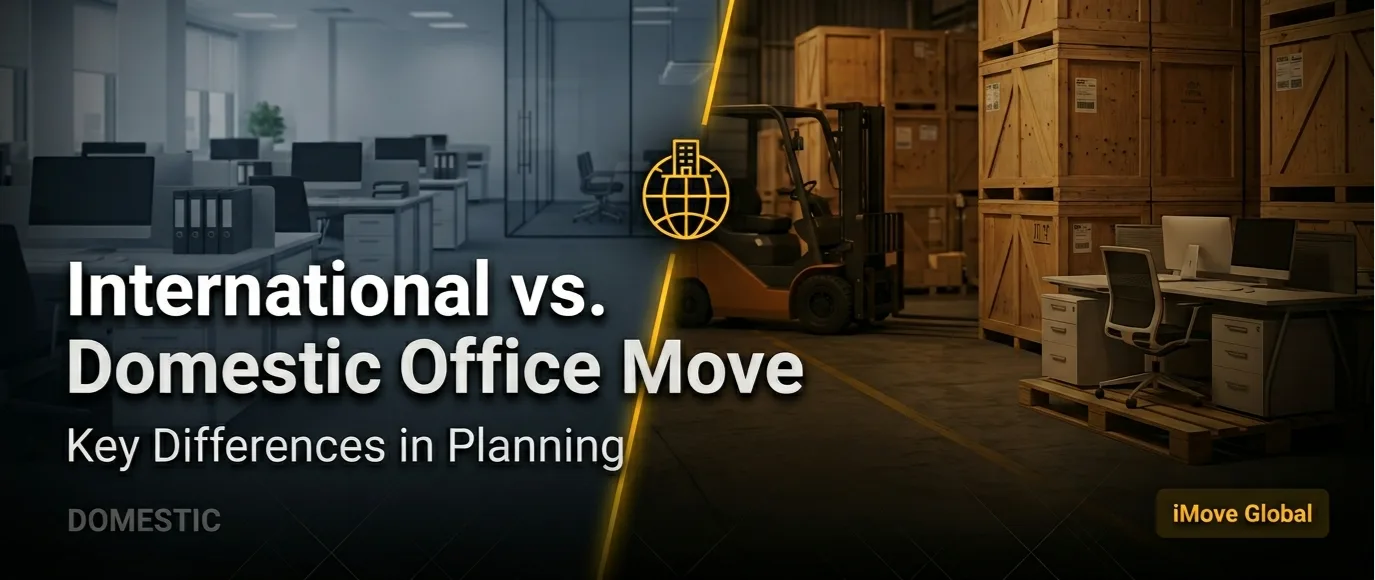
International Office Relocation vs. Domestic: Key Differences in Planning
When a company outgrows its space, the decision to move can feel straightforward — until the destination is in another country. International office relocation and domestic office relocation share the same end goal, but the planning, compliance, and logistics behind each are worlds apart. Understanding those differences before you start is what separates a smooth transition from a costly, drawn-out disruption.
Scale vs. Complexity: Why These Two Moves Are Fundamentally Different
A domestic office move — whether across the city or to a different state — operates within a familiar legal and logistical framework. You are dealing with known carriers, a shared currency, the same regulatory environment, and a planning timeline measured in weeks. The variables are manageable and largely predictable.
An international office relocation is a different category of challenge entirely. You are not just transporting furniture and equipment — you are moving assets across customs borders, navigating import duties, complying with destination-country regulations, and coordinating logistics across multiple time zones. The planning horizon stretches to months, the cost structure is more complex, and the margin for error is considerably smaller.
The comparison below captures the key planning differences at a glance. Every factor listed represents a decision point that will shape your budget, your timeline, and the partner you choose to work with.
| Planning Factor | Domestic Move | International Move |
|---|---|---|
| Typical planning window | 4–8 weeks | 3–6 months minimum |
| Customs clearance | Not required | Required — full commercial documentation |
| IT equipment compliance | Physical logistics only | Export controls, import duties, data sovereignty |
| Freight options | Road, rail | Sea freight, air freight, multi-modal |
| Regulatory permits | Local / state-level | Multi-country — origin and destination authorities |
| Cost predictability | High | More variables |
| Specialist expertise needed | Commercial mover | International relocation specialist |
| Project management scope | Internal coordinator workable | Dedicated move manager recommended |
The sections below unpack each of these factors in detail — covering what actually changes when your next office address is in a different country, and how to plan for it.
Regulatory, Customs, and Legal Compliance
For a domestic office move, regulatory requirements are relatively contained. You may need building permits, landlord approvals, a lease surrender agreement, and possibly local authority notifications depending on your premises. These are standard, predictable steps that your building manager or solicitor can typically handle without specialist support.
International office relocation introduces a fundamentally different compliance layer. Every item crossing a national border must be declared, categorized, and valued. Depending on the destination country, you will face some combination of the following:
- Customs duties and import taxes on office equipment, furniture, and electronics — applied even to used goods
- Prohibited and restricted goods — batteries, certain chemicals, and specific electronic components may require special permits or be restricted entirely
- Carnet ATA documentation for items being temporarily imported that will return to the origin country
- Commercial entity registration requirements in the destination country before goods can be formally received by your company
- Used goods restrictions — several markets apply higher duties or additional inspections to second-hand office furniture and equipment
The documentation burden alone can add four to eight weeks to your timeline if preparation is not started early enough. Many companies treat customs as a formality. In practice, a single incorrect commodity code on a commercial invoice can hold an entire shipment at port for weeks — costing far more in lost productivity and demurrage charges than the original duty itself.
Start customs preparation 8–12 weeks before your target move date. Work with a mover who provides a dedicated customs coordinator — not just a freight forwarder who outsources the documentation. Errors caught before shipment cost nothing. Errors caught at the border cost significantly more.

IT Equipment and Data: Cross-Border Rules That Catch Companies Off Guard
Moving IT equipment domestically is primarily a physical logistics challenge — inventory management, careful anti-static packing, de-installation, and reinstallation in the new premises. The equipment travels within the same regulatory environment it was purchased in, with no additional approvals required.
Cross-border IT moves add a compliance dimension that most companies are not prepared for, and that regularly catches experienced operations teams off guard.
Export Controls on Hardware
Hardware containing encryption technology — which includes most modern laptops, servers, network switches, and storage arrays — may be subject to export licensing requirements depending on the country of origin and destination country. Equipment manufactured in the United States, for example, may fall under EAR (Export Administration Regulations) or, in certain cases, ITAR controls. This is not a minor compliance footnote; non-compliance can result in seizure of the entire shipment at the point of departure.
Import Duties on Commercial Electronics
Many countries apply substantial import duties to commercial electronics arriving as part of a business relocation — even when the equipment is not being sold and is simply entering the country for operational use. Budget for this cost before the move date, not after the shipment clears customs.
Data Sovereignty Obligations
Moving servers and storage devices across borders may trigger data protection obligations in the destination country. GDPR applies to EU destinations; PDPA governs Singapore; India's DPDP Act applies to personal data being processed within India. Your IT team and legal counsel need to assess data residency and cross-border transfer requirements before a single storage device leaves the building. In some cases, data must be wiped before export and restored from a cloud backup at the destination — a step that adds time but eliminates legal exposure.
Serialized Asset Documentation
Customs authorities require a detailed asset inventory for all electronic equipment crossing the border — make, model, serial number, declared value, and HS commodity code for every item. This documentation exercise is time-consuming, must be accurate, and cannot be delegated to the removal team in the final week of packing. Build it into the planning schedule from the start.
Encryption-capable hardware may require an export license before it can legally leave its country of origin. Verify this with your international moving specialist and legal team before packing a single device. The consequence of non-compliance is not a fine — it is potential seizure of your entire shipment at departure.
Timeline and Project Management: How the Planning Window Changes
Timeline is where the gap between domestic and international office relocation becomes most visible — and most consequential. For a domestic move, a four-to-eight-week planning window is workable for most small-to-medium office environments. You can phase the move over a weekend and have staff operational in the new space by Monday.
An international office move attempted with the same informal approach will fail. The minimum realistic planning window is three months for a small office. Larger operations should budget six months or more, particularly when customs documentation, freight procurement, and destination setup all need to run as parallel workstreams.
The reason for this extended timeline is not bureaucracy — it is the number of interdependent workstreams that must run simultaneously across two countries. Customs documentation, freight booking, destination-office preparation, IT infrastructure setup, and staff communications all depend on each other, and delays in any one workstream cascade through the rest.
Professional move management services exist to coordinate exactly these workstreams. A dedicated project manager with cross-border experience will compress your effective timeline and eliminate the handoff gaps that cause compounding delays.
A Practical Planning Sequence for International Office Moves
-
01
Appoint a project lead and define the scope
Designate a single internal owner for the move. Decide which assets are being moved, which are being disposed of, and which staff are relocating. These decisions need to be made in month one — not month three.
-
02
Conduct a full asset inventory
Document every item being moved — furniture, IT hardware, servers, printers, archives. For electronic equipment, record make, model, serial number, and approximate declared value. This feeds directly into customs documentation.
-
03
Engage your international relocation specialist early
The sooner your mover is involved, the more options you have — particularly around freight booking, customs pre-clearance, and timeline planning. Late engagement limits your choices and increases cost.
-
04
Begin customs documentation in parallel
Commercial invoices, packing lists, HS commodity codes, and any required import permits should be prepared concurrently with freight booking — not after. This is the step most companies underestimate, and the one most likely to cause a delay at the border.
-
05
Confirm freight method and book capacity
Decide on sea freight, air freight, or a combination, and confirm bookings. Sea freight capacity on key routes needs to be secured weeks in advance, particularly during peak shipping seasons.
-
06
Prepare the destination office in parallel
IT infrastructure, utilities, furniture fit-out, and company address registration in the new country should all be progressing while your shipment is in transit. Waiting until goods arrive to start this work creates avoidable downtime.
-
07
Plan a phased handover to protect operations
Avoid a single cutover date where everything moves simultaneously. A phased handover — critical systems first, non-essential assets last — significantly reduces operational risk and gives you a recovery path if any element of the move is delayed.
Cost Structures: What Changes at the Border
The cost of a domestic office move is relatively predictable: a removal company, packing materials, transport to the new premises, and any fit-out or reconnection work at the destination. Surprises are generally minor — an extra day of van hire, a broken screen.
International office relocation introduces cost categories that do not exist domestically, and that are consistently underestimated during early-stage planning. Understanding each of these in advance is the difference between an accurate budget and a difficult conversation with your finance team mid-move.
Freight Costs: Sea vs. Air
Freight method is the single largest cost variable in any international office move. Sea freight is substantially cheaper for high-volume shipments but adds two to six weeks of transit time depending on the route. Air freight is six to ten times more expensive per kilogram but delivers in days. For most corporate relocations, a combination approach works best — bulk furniture and non-urgent assets by sea, IT equipment and business-critical items by air. For a full cost comparison by route and shipment type, see our detailed guide on sea freight vs. air freight options for international moves.
Customs Duties and Import Taxes
Destination-country import duties on commercial equipment and furniture can add 10–30% to the landed cost of certain asset categories. These duties apply to second-hand goods as well as new ones, and they apply even when the equipment is simply moving with your company — not being sold. Factor this into your budget before the move, not after customs clearance has already occurred.
Transit Storage
When the destination office is not ready to receive goods at the same time the origin office vacates, your shipment needs somewhere to go. Storage-in-transit costs — warehousing fees, extended insurance, in-and-out handling charges — are rarely included in first-draft budgets and frequently cause overspend. Plan for a two-to-four-week transit storage window as a default buffer.
Destination Agent Fees
Your mover's local partner in the receiving country handles on-the-ground coordination: port clearance, local delivery, and installation. Their fees are a legitimate and unavoidable cost of an international move. A reputable international relocation partner will include destination agent costs in their initial quote. If a quote does not mention them, ask — they will appear on an invoice eventually.
Currency Risk
Any move that spans several months involves currency exposure. Get all quotes in the currency you will ultimately pay in. For large shipments where freight and duties represent significant sums — particularly on routes between India, UAE, and Singapore — consider whether a forward currency contract is appropriate. Exchange rates can move meaningfully over a three-to-six-month planning window.

Choosing the Right Office Relocation Partner for Your Move
For a domestic office move, most reputable commercial moving companies can handle the job competently. The key selection criteria are a track record with commercial clients, adequate goods-in-transit insurance, and availability on your required timeline.
An international office relocation requires a specialist. The difference is not simply one of scale — it is expertise in a completely different discipline. The wrong partner will cost you more in delays, documentation errors, and customs complications than the right partner charges in fees.
In-House Customs Expertise
Your mover should have dedicated customs coordinators on staff — not a freight forwarder who subcontracts the documentation to a third party you have never spoken to. Customs errors are the single most common cause of international office move delays, and they are almost entirely preventable when documentation is prepared and reviewed by an experienced coordinator before the shipment moves.
A Vetted Global Agent Network
A credible international mover operates through established destination agents, not ad hoc subcontractors sourced when the shipment arrives. This is what enables genuine door-to-door service — accountability at both ends of the move, with a single company owning the outcome. When evaluating any prospective partner, ask directly who handles last-mile delivery and installation in the destination city, and what the nature of that relationship is.
Specialist IT Equipment Handling
Office IT equipment requires anti-static packing, climate-controlled transport for sensitive servers and storage hardware, and precise serialized documentation for customs clearance. Verify that your mover has specific operational procedures for server racks, network hardware, and workstations — not just generic fragile-item handling applied to everything. This level of specialization is particularly important for IT equipment moving across borders, where customs authorities require asset-level accuracy.
End-to-End Project Management
The best international office relocation partners assign a dedicated project manager from first consultation through to final installation at the destination. For a complex cross-border move, a single point of contact who understands both the origin and destination requirements — and who owns the timeline — is not a premium feature. It is the most reliable way to protect your business from the compounding delays that undefined ownership creates.
Planning an office move — domestic or international? iMove Global's office relocation specialists provide dedicated project management, specialist IT equipment handling, and in-house customs support across India, UAE, and Singapore.
View Office Moving ServiceThe Difference Is More Than Distance
The gap between international office relocation and domestic is not simply a matter of distance — it is a fundamentally different planning exercise. Companies that approach a cross-border move with a domestic mindset consistently underestimate the timeline, the documentation requirements, and the cost variables that only exist when a shipment crosses a customs border.
Starting early, engaging the right specialist from the beginning, and treating customs documentation as a first-priority workstream rather than a final formality are the three decisions that most reliably determine whether an international office move runs to plan. Everything else — freight method, cost structure, IT compliance — falls into place more easily once those foundations are set.
If your company is planning a relocation and you are not yet certain which category your move falls into, our team at iMove Global can help you map the scope, assess the customs and freight requirements, and build a realistic timeline. Explore our full office moving service or get in touch for a free consultation.
Key Takeaways
- International office relocation requires a planning window of 3–6 months minimum — versus 4–8 weeks for a domestic move.
- Customs documentation should begin 8–12 weeks before your target move date; errors at this stage are the leading cause of international office move delays.
- IT equipment crossing borders may be subject to export controls, import duties, and data sovereignty requirements that do not apply domestically.
- Freight method — sea vs. air — is the single largest cost variable in any international office move; most relocations benefit from a combination of both.
- Budget for costs unique to international moves: customs duties, transit storage, destination agent fees, and currency exposure across a multi-month timeline.
- An international office relocation requires a specialist — not just a commercial mover — with in-house customs expertise, a global agent network, and dedicated project management.
Planning an Office Move? Talk to a Specialist.
Whether you are relocating your office across the city or moving your entire operation to a new country, iMove Global provides end-to-end office moving services — with dedicated project management, in-house customs support, and specialist IT equipment handling across India, UAE, and Singapore.